
Plasterboard on a damp Maltese wall: why it fails
Plasterboard over a wet wall does not dry the wall. It conceals rising damp, rain penetration and condensation behind a sealed void, and salt-contaminated plaster keeps pulling moisture in regardless. Here is what the Maltese evidence and the law actually say.
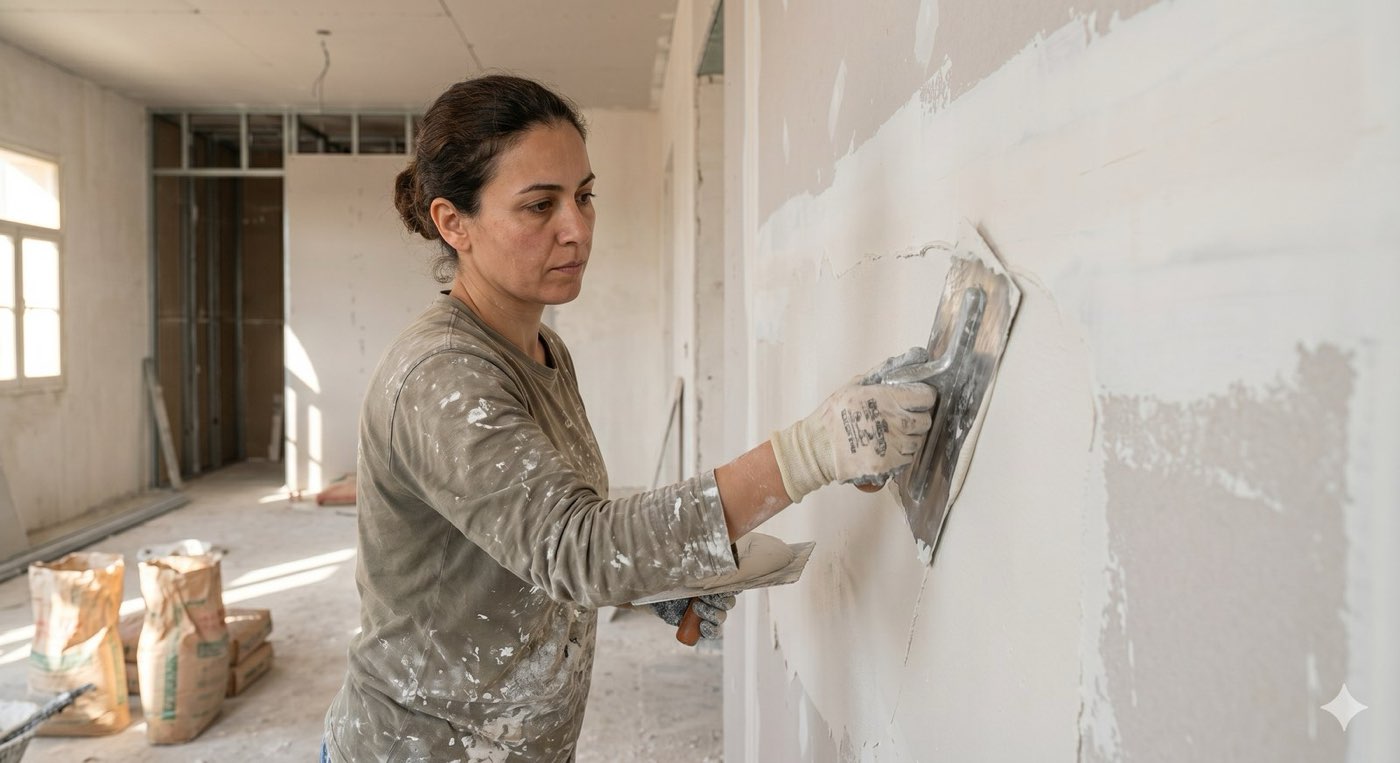
What boarding over damp actually does
A homeowner finds a stained, blistering wall, gets a quote to batten it out and board it, and the stain disappears in a day. Nothing has been fixed. The wall behind the board is the same wall it was that morning, and it is now out of sight.
Three things follow. The wall keeps carrying moisture, because nothing about a sheet of plasterboard interrupts the mechanism that brought the water there. Any salt-contaminated plaster left on the wall carries on pulling moisture out of the air. And the void between board and wall becomes a space nobody looks at, fed by a substrate that — as the Maltese evidence on porous globigerina and stone walls puts it — absorbs and releases moisture slowly, for weeks at a time.
That is the problem in one line: plasterboard is a finish, and damp is a building defect.
The three sources, and the humidity that compounds them
A 1990 University of Malta dissertation assessing a typical Maltese terraced house identified three sources of dampness — rain penetration, rising damp and condensation — together with the building defects behind each. Thirty-odd years later a Maltese consumer guide describes the same picture for flats, adding structural defects such as roof leaks and outdoor humidity as a distinct driver.
Rising damp
Rising damp is endemic in Malta's built stock, which is mostly Lower Globigerina Limestone. The stone is porous; that is the whole mechanism. This is not a quirk of old farmhouses — it is the default behaviour of the material most of the island is built from.
A 2018 Master's dissertation tested electro-osmosis as a drying method on limestone samples. It controlled moisture movement in the laboratory but concluded that further study was needed. Read that as a warning: there is no proven local cure-all, and anyone selling one is ahead of the published evidence.
Rain penetration
Water driven through external walls or in through a roof defect. The Maltese case study ties dampness to identifiable building defects rather than to bad luck, and the flat-level guidance lists roof leaks explicitly. Rain penetration is seasonal and directional, which is why it is often mistaken for rising damp on a ground-floor wall.
Condensation
Cooking, showers and laundry put water into the air; cold surfaces take it back out. Malta's outdoor relative humidity averages about 76%, and poorly ventilated flats reach 85-95% indoors between October and February — precisely the months when damp complaints peak. The healthy indoor range is 40-60%, and a reading consistently above 60% signals a problem.
Condensation matters here because it is the one source plasterboard can make worse. Board a cold external wall without addressing ventilation and you have added a surface, a void and no extra air change.
Salts are the reason the plaster has to come off
This is the part that gets skipped. UK guidance on rising damp and replastering is unambiguous: installing a damp-proof course cannot undo salt damage already in the plaster. Hygroscopic salts deposited by years of evaporation keep drawing moisture from the air on their own. The contaminated plaster must be removed and replaced.
So the sequence is not "stop the damp, then board". It is "stop the damp, strip the contaminated plaster, replace it, then board if you still want to". Fix the source and leave the salty plaster in place and you have a wall that still goes damp in October.
The same UK guidance cites BS 6576:2005 for the diagnosis of rising damp. That is a British standard, and we use it here because there is no Maltese equivalent to use instead.
What the law says, and what it leaves out
Waterproofing and damp in Malta are still governed by article 97 of the Code of Police Laws (Cap. 10) — mid-19th-century provisions, as the Kamra tal-Periti set out in its 2020 framework paper. They refer to ventilated basements and cavity walls as means of restricting damp from the ground and through external walls, and they put the onus on the perit to provide proper damp-proof courses.
Two consequences for a homeowner:
- There is a legal duty on the perit regarding damp-proof courses, so on works where a perit is engaged, damp is their province and not something to settle informally with a plasterer.
- There is no modern performance code behind that duty: no published method, no specified materials, no acceptance criteria. The Kamra's own paper is an argument that the framework needs modernising.
Gypsum works themselves sit outside this entirely. Boarding is finishing work. It does not require, and cannot substitute for, the damp-proofing decision.
Before any board goes up
- Measure. A hygrometer costs under EUR 20 in Malta. Log the room, morning and evening, for a week. If you are consistently over 60% you have a problem to name before you spend on finishes.
- Name the source. Rising damp, rain penetration, condensation or a structural defect such as a roof leak. These have different fixes and the wrong fix is money gone.
- Fix the source, with a perit involved where the defect is structural or where damp-proof courses are in question.
- Strip the salt-contaminated plaster and replace it. A damp-proof course does not neutralise salts already in the render.
- Let the wall dry. Globigerina gives moisture back slowly, over weeks. Nobody publishes a target reading for Malta, so this has to be judged on the wall itself.
- Then board — for level, for services, for insulation, for whatever reason you wanted board in the first place.
Flats, shell form and Gozo
In an apartment, the damp may not originate inside your demise. A roof defect or a failure in an external wall is likely to involve common parts, which means the condominium rather than you alone, and that conversation has to start before anyone quotes for finishes. Boarding your side of a wall fed from a common element does not make the moisture your private problem to hide.
Property sold in shell form is handed over before finishes, which is the ideal moment to look at bare walls honestly. It is also the moment at which a wall that will be damp in January looks perfectly dry in July.
For Gozo, note only that remediation materials come over on the ferry like everything else, which affects scheduling more than it affects method.
Living with the humidity afterwards
Even a correctly remediated wall sits in a climate averaging about 76% outdoor relative humidity. A mid-range dehumidifier costs EUR 120-200 and the target indoor band is 40-60%. Ventilation and moisture control are ongoing household management, not a one-off build item — and no amount of plasterboard changes that.
Common questions
- Can plasterboard be used to cover a damp wall in Malta?
- It can be fixed there, but it does not dry the wall or stop the damp. The wall stays wet, any salt-contaminated plaster left behind keeps drawing moisture from the air, and the void behind the board is not ventilated or inspectable. The source of the damp has to be dealt with first, and contaminated plaster removed, before boarding is anything other than concealment.
- How do I know whether my wall is actually damp or just cold?
- Buy a hygrometer — they cost under EUR 20 in Malta — and log the room over several days. Healthy indoor relative humidity is 40-60%. Readings consistently above 60% indicate a problem, and poorly ventilated flats reach 85-95% between October and February. That tells you the room is humid; it does not tell you whether the moisture is rising damp, rain penetration or condensation, which is a diagnostic job.
- Is there a Maltese standard for diagnosing rising damp?
- Not one that we can point to. The main published diagnostic reference used in this trade is British — BS 6576:2005, cited in UK rising-damp guidance. Maltese law treats damp through article 97 of the Code of Police Laws (Cap. 10), mid-19th-century provisions about ventilated basements and cavity walls, and puts the onus on the perit to provide proper damp-proof courses. That is a duty, not a method.
- How long should a wall dry before boarding?
- Nobody publishes a figure for Malta. What is documented is that porous globigerina and stone walls absorb and release moisture slowly, over weeks. Any drying period should be measured on the actual wall rather than taken from a rule of thumb, and the measuring is not something the sources give a method for.
- Does a damp-proof course fix a wall that has already been damp for years?
- No. UK guidance is explicit that a damp-proof course cannot undo salt damage already present in the plaster. Hygroscopic salts left in the plaster keep drawing moisture out of the air, so the contaminated plaster has to be removed and replaced even after the rising damp itself has been stopped.
What we could not establish
- No Maltese body publishes a standard method, specification or sequence for damp remediation; the main technical reference in general use is British (BS 6576:2005, via UK guidance).
- No published Maltese price range for damp remediation, replastering of salt-contaminated walls, or chemical damp-proof course installation.
- The sources do not state how long a globigerina wall takes to dry to a boardable condition, nor what moisture reading counts as dry enough.
- No Maltese source documents mould growth rates or failure rates in the void behind plasterboard fixed to damp walls; the reasoning here is from the moisture behaviour the sources do establish.
- The sources do not say which damp-proofing systems, membranes or renders perform in Lower Globigerina Limestone; the one Maltese study cited here tested electro-osmosis in the laboratory and concluded it needs further study.
- LN 227/2016, Technical Document F and the condominium rules under Cap. 398 are not addressed by any of these sources in relation to damp.
Sources
- Damp Apartment Malta: Fix Moisture Problems Fast (25 Jun 2026) — Rozie.app (Malta) · read 2026-10-05
- Humidity in Malta Apartments: Your 2026 Control Guide (22 Jun 2026) — Rozie.app (Malta) · read 2026-10-05
- The problem of dampness inside buildings: assessment of a typical terraced house (B.E.&A. dissertation, 1990) — University of Malta (OAR@UM), David Farrugia · read 2026-10-05
- Drying limestone through electro-osmosis (Master's dissertation, 2018) — University of Malta (OAR@UM), Paul Dalli · read 2026-10-05
- A Modern Building & Construction Regulation Framework for Malta (PDF, 2020) — Kamra tal-Periti · read 2026-10-05
- Rising damp and its control: replastering — Safeguard Europe Ltd (UK) · read 2026-10-05
Drafted with Claude — claude-opus-5, then read, corrected and approved by Neil Bennett before publication. We do not publish anything a person has not read.
Want this costed properly?
The calculator gives you a figure in a minute. A site visit gives you a fixed price.
Book a free survey