
Why gypsum ceilings crack and how to stop it
Cracks along board joints and at the wall-ceiling junction are the commonest complaint in new Maltese apartments. The board is rarely the cause. Here is what actually moves, what the Maltese specification asks for, and how a failed joint is repaired.
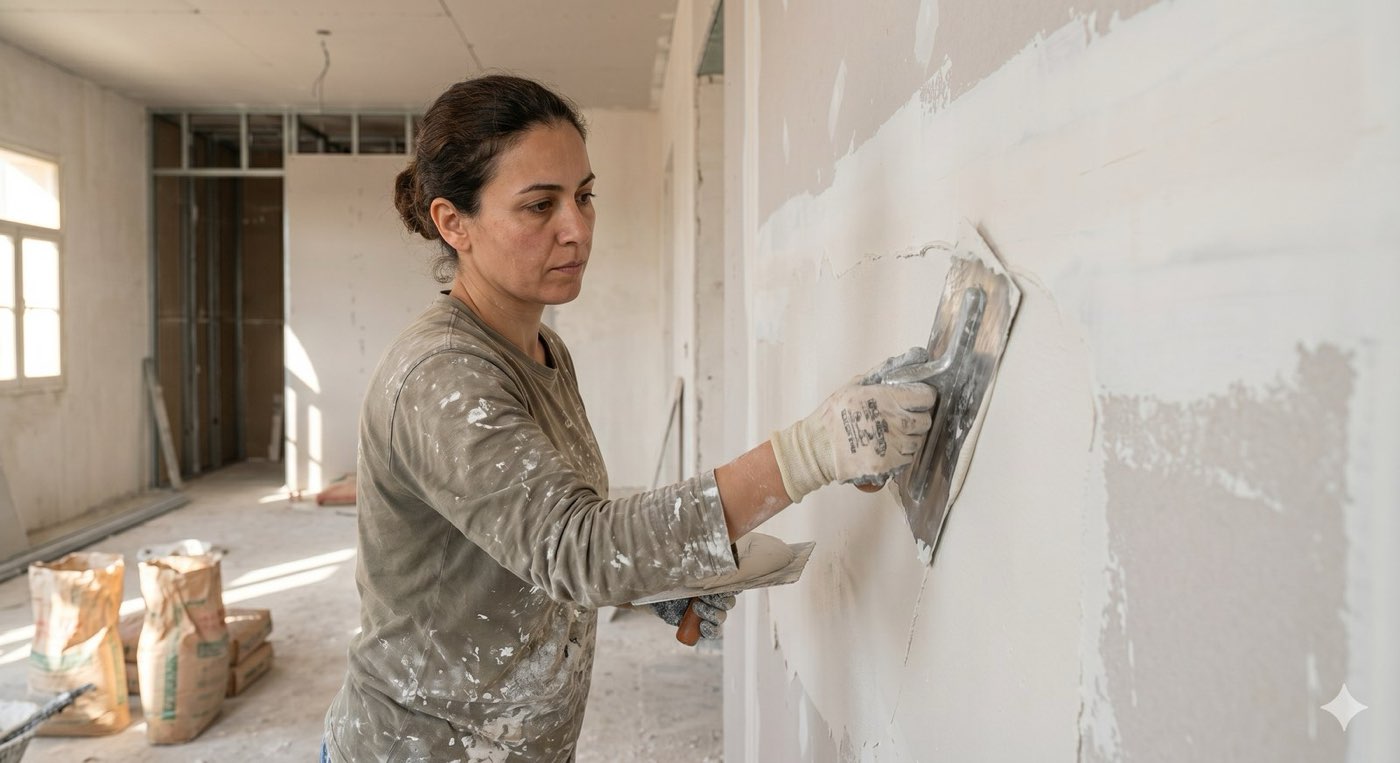
Somebody hands over a finished apartment in March. By August there is a fine line running along the ceiling, straight as a ruler, about 1.2 m from the wall. By the following spring it has faded and a second one has appeared where the ceiling meets the wall. The owner assumes the boards were cheap.
They almost never are. A crack that follows a straight line is following a joint, and a joint is something a person made.
Read the crack before you fill it
The geometry tells you most of what you need.
- Straight, along a line 1.2 m or a multiple of it from a wall — a board joint. The taping failed, or the joint is being pulled apart by movement.
- Along the wall-ceiling junction, all round the room — the internal angle. Either the two planes are moving relative to each other, or the corner was taped with the wrong material.
- A row of small circular pops or dimples — fixings, not joints.
- Diagonal, crossing a board face, ignoring the joints — this is not a jointing question. Get it looked at by whoever is responsible for the structure.
Everything below concerns the first three.
What actually moves
The US inspection literature on drywall cracking sets out the mechanisms, and they transfer to Malta without much editing.
Thermal and humidity movement over long runs. Boarded surfaces expand and contract. On runs longer than about 30 ft — roughly 9 m — that movement has to go somewhere, and without a control joint it goes into the weakest line in the assembly, which is a taped joint. Long corridors and open-plan living-dining runs in Maltese apartments comfortably exceed this. Maltese summers make the temperature swing across the void larger than the one the detail was borrowed from.
Framing shrinkage and movement. If the framing behind the board moves, the board goes with it. In Malta the framing is usually steel profile fixed back to limestone and to a concrete slab, which does not shrink the way timber does — but the fixing substrate matters. Board fixed to a very new slab or to freshly built blockwork is attached to something that has not finished settling and drying.
Mesh tape at corners. Self-adhesive mesh tape at internal angles appears explicitly on the list of causes. It is fast, it is convenient, and it is the wrong choice at the corner where the ceiling meets the wall.
Missing control joints. Not an extra. On a long run they are the thing that decides where the movement goes.
Taping temperature. Compound applied in the wrong temperature conditions cracks afterwards. A joint filled during a July afternoon on an unshaded top-floor apartment, then living out its life in a cooled room, has been set up to fail.
Shell form compresses the programme. Property here is normally sold as a shell, and the gypsum contractor arrives after the structure is finished but often not long after. That is a commercial reality, not a defect, but it is the point at which "the slab is new" becomes a question somebody should ask out loud.
What the Maltese specification asks for
The Malta Enterprise bill of quantities for gypsum works (MLSC/FIN/GYP/BOQ/08/15) is a useful benchmark because it is a public document describing what a client specifying properly actually buys. It calls for:
- double 12.5 mm board;
- taped joints — named as a line item, not left to the installer's habit;
- polythene and acoustic sealant at the perimeter;
- a skim coat finish;
- inspection manholes where access is needed.
Read against the crack causes, the interesting entries are the taped joints and the sealed perimeter. Taping is specified because it is the thing that holds a joint together; a perimeter that is sealed rather than rigidly locked is a perimeter that can absorb a little movement. If a quotation you have been given does not mention how joints are taped, that is not a small omission — it is the one variable most strongly associated with the failure you are trying to avoid.
There is no trade licence for gypsum work in Malta. The written specification and the warranty are, in practice, the whole of your protection.
The materials are on the shelf
None of this depends on importing anything unusual. Maltese hardware suppliers stock gypsum boards and steel profiles alongside jointing tape, angle beads, ready-mix compound and screws. The fix uses ordinary trade stock. In Gozo every delivery involves a ferry, which affects scheduling and what a contractor is willing to make a second trip for — worth settling before the job starts rather than when a snag appears.
Repairing a joint that has already cracked
- Watch it first if you can. A crack that opens in summer and closes in winter is a movement crack and needs a control joint or a relieved detail. Filling it will buy you one season.
- Cut it out. Rake the failed compound out of the joint and remove the old tape entirely. Mesh tape found at an internal angle should come out on principle.
- Check the fixings. If the board is loose from the profile behind it, add screws before any compound goes on. A joint cannot hold two boards still if the boards themselves are free to move.
- Re-tape. Paper tape bedded in compound at internal angles. Angle beads where an external corner has been damaged.
- Build up in thin coats, each allowed to dry, and avoid taping in temperature extremes — the same condition that caused the original failure will cause the repair to fail.
- Add a control joint if the run is long enough to warrant one. Better a deliberate line you chose than a random one the building chooses for you.
- Skim, then paint. Painting over a repair that has not been skimmed back into the surrounding surface leaves a visible band under raking light, which in a Maltese apartment with large glazed openings is most of the day.
At the wall-ceiling junction, coving is the conventional local answer: it covers the corner and decouples the visible line from the movement. Local practice is that profile type and site conditions drive the price, so a coving quote that comes with no questions about the room has not been costed.
What a warranty is actually for
A warranty on gypsum work is a warranty on workmanship — the jointing, the taping, the fixing, the framing, the finish. That is the right scope, because that is where cracks come from. It is not an undertaking about the structure behind the board, and no honest contractor will offer one.
Two practical consequences. First, if a crack appears within the warranty period along a board joint or an internal angle, it is a workmanship question and should be looked at, not argued about. Second, if you are having work done to a ceiling in an apartment block, anything touching common parts is bound by the condominium rules under Cap. 398, and getting that agreement in writing before work starts is cheaper than getting it afterwards.
Cracks in a gypsum ceiling are boring, repeatable and preventable. That is the good news: nothing in the list above requires exotic materials or unusual skill. It requires the right tape, a control joint where the run is long, fixings into something that has stopped moving, and a person who is not filling joints in the hottest hour of a July afternoon.
Common questions
- Is a hairline crack along a ceiling joint a structural problem?
- Usually not. The crack patterns that follow board joints, screw lines or the wall-ceiling junction are the signature of movement and jointing method — thermal and humidity movement on long runs, framing shrinkage, the wrong tape at corners, missing control joints, or compound applied at the wrong temperature. A crack that wanders diagonally across a board face, rather than following a joint, is a different question and belongs to whoever assessed the structure, not to the plasterer.
- Should the joints be taped with paper tape or self-adhesive mesh?
- The engineering literature on drywall cracking specifically lists mesh tape used at corners among the causes of cracking. Paper tape bedded in compound is the safer choice at internal angles. Both tape types are sold by Maltese hardware suppliers alongside angle beads, ready-mix compound and screws, so availability is not the constraint — the choice on site is.
- Why does the crack open in summer and close again?
- Because the assembly is moving. Thermal and humidity movement is a recognised cause of cracking, particularly on runs longer than about 30 ft (roughly 9 m) without a control joint, and compound applied in the wrong temperature conditions cracks later. A crack that opens and closes seasonally needs a control joint or a relieved detail, not another coat of filler.
- Can I just fill it and repaint?
- You can, and it will come back if the cause is still there. A repair that lasts means cutting out the failed joint, checking the board is properly fixed, re-taping, building the compound up in thin coats, re-skimming and only then painting — and adding a control joint if the run is long enough to need one.
What we could not establish
- No Maltese source documents how common ceiling cracking is in new local apartments, or which of the causes dominates here. The mechanisms in this article come from US inspection literature read against the Maltese specification.
- Control joint spacing: the 30 ft figure is from a US source. Nobody publishes a spacing recommendation calibrated to Maltese summer temperatures or to boards fixed to concrete slabs.
- No source states how long a new concrete slab or a newly built block wall should be left before boards are fixed to it, or how that is verified on site.
- No Maltese source publishes a rate for crack repair. The only local pricing statement available says that profile type and site conditions drive the price, without figures.
- The cited sources say nothing about Maltese regulation — clear-height rules, Technical Document F, condominium common parts under Cap. 398 — or about trade licensing for plasterers. Those points come from the instruments themselves and are treated as background here.
- No source sets out a standard warranty period or warranty wording for gypsum work in Malta.
Sources
- Drywall Cracks - Cause & prevention of cracks or ridging in plasterboard ceilings & walls — InspectAPedia (US) · read 2026-09-21
- Bill of Quantities MLSC/FIN/GYP/BOQ/08/15 — Malta Enterprise · read 2026-09-21
- Gypsum Boards & Steel Profiles (online shop) — Kenneth Hardware Stores (KHS Malta) · read 2026-09-21
- Professional Coving Malta — GypsumWorks Malta · read 2026-09-21
Want this costed properly?
The calculator gives you a figure in a minute. A site visit gives you a fixed price.
Book a free survey