
Plasterboard vs traditional plaster in a Maltese townhouse
Old franka limestone and hollow-block walls can be skimmed, re-plastered or dry-lined. The decision turns on moisture, thermal performance and how long you can live around the work — not on how the finished wall looks.
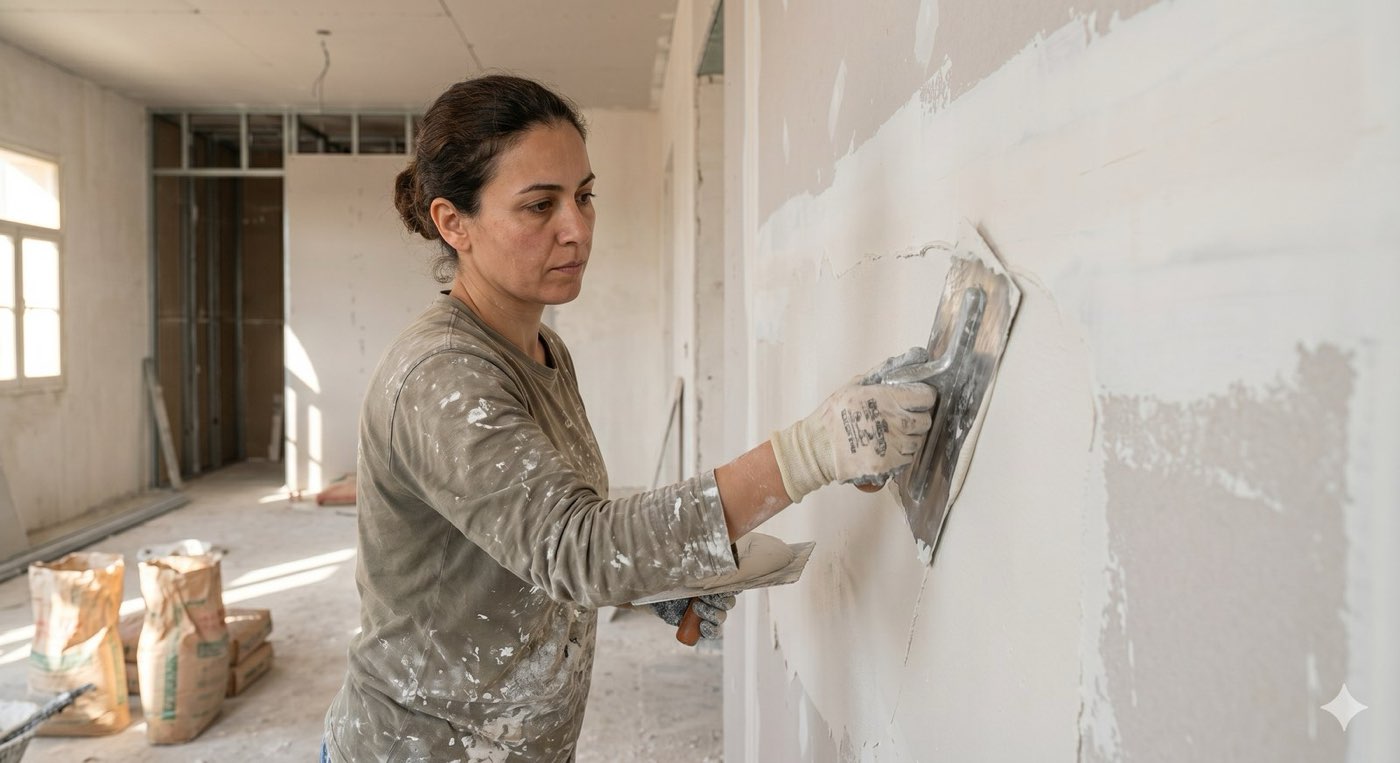
Most people arriving at this question have already decided the wall needs doing. What they have not decided is whether the answer is a skim over what is there, a full re-plaster, or a frame and plasterboard in front of the old stone. In Malta those three are genuinely different jobs with different consequences, and the differences are about moisture, heat and disruption rather than about the finished surface. A well-executed skim and a well-executed board-and-skim look the same from the sofa.
What you are actually working with
A Maltese townhouse is normally solid franka limestone at the older parts and hollow concrete block where it has been extended or subdivided. Neither behaves like a British cavity wall with a plasterboard lining already on it. The stone is thick, absorbent and rarely flat, and the block is flat but thin.
Thickness is the trap. EPC Malta's comparison of eight Maltese wall types puts a solid 230 mm limestone wall at 2.51 W/m2K — a heavy, substantial wall that performs badly. Adding stone does not buy insulation. Adding insulation buys insulation: the same comparison puts a wall with 50 mm of insulation behind board at 0.42 W/m2K.
What dry-lining actually buys you
| Wall | U-value (EPC Malta) |
|---|---|
| Solid 230 mm limestone | 2.51 W/m2K |
| With 50 mm insulation behind board | 0.42 W/m2K |
That is the whole thermal argument in two lines. A skim coat is millimetres of finish and does not move the number. A full sand-cement or gypsum re-plaster does not move it either. Only an insulated build-up behind the board moves it, and it moves it by a factor of roughly six.
For a townhouse with a west-facing bedroom that is unusable in August, that is the relevant fact. For a north-facing internal wall between two heated rooms, it is irrelevant, and you should just plaster it.
Where Technical Document F comes into it
British readers reach for Part L. The Maltese instrument is the BCA's Technical Document F Part 1, which sets minimum energy performance requirements for dwellings and the building envelope. It carries new-build values in Table 2 and renovation values in Table 3, and it requires replaced envelope elements to meet those tables even where the work is not a major renovation. EPC Malta cites the Document F wall limits as 1.22 and 1.57 W/m2K, with 1.57 W/m2K the number that applies in a renovation.
Two practical consequences. First, a solid limestone wall at 2.51 W/m2K is nowhere near 1.57, and an insulated dry-lining at 0.42 is comfortably past it — so if the obligation is triggered, a skim will never satisfy it and a dry-lining will. Second, the obligation is narrower than people assume: it bites on new or replaced envelope elements. Re-finishing a wall that stays where it is may well not trigger anything. Whether your particular scope counts as a replacement is a question for your perit and the BCA, and the published document does not answer it for you. Do not let a contractor tell you either way as though it were settled.
Time on site, and living in the house
GypsumWorks Malta quotes 1-3 days per room for interior plastering, and works to the ordinary Maltese division: gypsum plaster inside, cement-based render outside. That is the benchmark to hold a board job against.
A framed, insulated, boarded and skimmed wall is more stages — set out and fix the frame, insulate, board, tape and joint, skim, and let each stage dry. Nobody in these sources publishes a day count for that in Malta, so treat any contractor's figure as their estimate rather than an industry norm and get it in writing.
Against the extra days, dry-lining gives you a chase-free route for cables and sockets, a flat plane in a house that has none, and the insulation. Re-plastering gives you the wall back faster, keeps the room's full floor area, and does not change the ceiling height. In a townhouse with a low mezzanine or a converted kamra ta' fuq, the build-up matters: habitable rooms in Malta are held to a 2.60 m clear height under LN 227/2016, and both a dropped ceiling and a thick lining eat into it. Measure before you specify, not after.
Which board goes where
Board grade is not an upsell, it is a specification. The Maltese range at Evolve (RS Group, Haz-Zebbug) is a fair guide to what is actually stocked here:
- CoreX standard — dry rooms: bedrooms, living areas, corridors, ceilings.
- CoreX moisture — the wet-room grade, the green-faced board people ask for by colour. Bathrooms, shower rooms, behind a kitchen run.
- CoreX fire — where fire performance is specified, typically protected shafts, service risers and separating construction.
- BoardeX exterior — the exterior board, for facades and external soffits rather than internal partitions.
The same supplier carries Knauf and Derztek jointing and skim compounds, which is the finishing side of the same decision.
Two cautions. Moisture-resistant board is a board grade, not a waterproofing system — none of these sources says it substitutes for tanking behind tiles in a shower. And exterior board is not a licence to put gypsum systems on a weather-exposed Maltese facade without proper detailing; GypsumWorks' own rule of thumb is gypsum inside, cement-based outside.
Cost, and why nobody quotes it here
Shaw Contractors' Maltese price guide identifies the things that actually drive a plastering price: the condition of the substrate, the number of coats, and the finish level required. Those are the right questions to be asked. GypsumWorks quotes either per square metre or as a fixed price after an inspection.
None of the sources behind this article publishes a rate, so this article publishes none. Use the calculator on the homepage for indicative figures and expect a real number only after somebody has stood in the room. In an old townhouse the substrate condition is the single biggest unknown, and a price given over the phone from photographs is a guess.
If it is a flat rather than a townhouse
Two Maltese constraints that do not exist in the UK version of this decision. Works touching condominium common parts — party structures, facades, shafts — fall under the condominium rules in Cap. 398 and need the condominium's agreement, not just yours. And if the property is in Gozo, every pallet of board crosses on the ferry, which affects lead times and delivery scheduling in ways that are worth asking about before the frame goes up rather than after.
A short decision list
- Is the wall damp? Resolve the moisture source first. Neither plaster nor board is a damp remedy.
- Is it an external wall on a hot elevation? That is the case for insulated dry-lining, and the 2.51 to 0.42 W/m2K difference is the reason.
- Is it an internal partition or a shaded party wall? Re-plaster it. You are buying a flat surface, not performance.
- Are you replacing envelope elements? Check Table 3 of Document F with your perit before you specify the finish.
- Wet room? Specify the moisture grade in writing, and keep tanking as a separate line item.
- Tight on head height? Measure to 2.60 m before committing to a lining build-up.
Common questions
- Does skimming an old limestone wall make it warmer?
- No. EPC Malta puts a solid 230 mm limestone wall at 2.51 W/m2K. A skim coat is a few millimetres of finish and does not change that figure in any meaningful way. The same source puts an insulated wall with 50 mm of insulation behind board at 0.42 W/m2K, so it is the insulation, not the board or the plaster, that does the thermal work.
- Do I legally have to insulate when I re-do the walls in a townhouse?
- Not simply because you are replastering. Technical Document F Part 1 sets renovation U-values in its Table 3 and requires replaced envelope elements to meet Tables 2 and 3 even outside a major renovation; EPC Malta cites the Document F limits as 1.22 and 1.57 W/m2K, with 1.57 W/m2K the figure that applies to a wall in a renovation. Whether a re-plaster or a dry-lining counts as replacing an envelope element is a question for the BCA and your perit on your specific job — the published sources do not settle it.
- Which plasterboard goes in a shower room?
- The moisture-resistant grade. Evolve's Maltese range lists CoreX in standard, moisture and fire grades, plus BoardeX as an exterior board. Moisture-resistant board is the wet-room grade in that range; none of the sources say it replaces tanking or a waterproof membrane behind tiles, so treat it as a board specification and not as waterproofing.
- How long does plastering a room take in Malta?
- GypsumWorks Malta quotes 1-3 days per room for interior plastering, depending on the room. No Maltese supplier or contractor in these sources publishes a comparable day count for a framed, boarded and skimmed dry-lining job, which involves more separate stages.
What we could not establish
- No source here publishes a price. Shaw Contractors sets out the cost drivers - substrate condition, number of coats, finish level - and GypsumWorks Malta says it quotes per square metre or as a fixed price after inspection, but neither states a rate, so this article gives none.
- No published duration for a board-and-skim job per room in Malta, only the 1-3 days per room GypsumWorks gives for interior plastering.
- Whether re-plastering or dry-lining an existing wall counts as 'replacing an envelope element' under Technical Document F is not stated in the document extract relied on here.
- None of these sources address the interaction between dropped ceilings, dry-lining build-up and the 2.60 m clear-height minimum for habitable rooms under LN 227/2016.
- No source establishes the moisture behaviour of plasterboard against damp franka limestone, rising damp in party walls, or whether a ventilated cavity behind the board is required.
- Nothing here on ferry surcharges or lead times for delivering boards to Gozo.
Sources
- Do thicker walls mean better insulation? Comparing 8 Maltese wall types (6 Aug 2026) — EPC Malta · read 2026-09-21
- Technical Document F Part 1: Dwellings - Minimum Energy Performance requirements and building envelope — Building & Construction Authority (BCA), Malta · read 2026-09-21
- Plastering Service Malta — GypsumWorks Malta · read 2026-09-21
- Plastering Cost Malta: Price Guide — Shaw Contractors · read 2026-09-21
- Gypsum Boards & Plaster Malta — Evolve - By RS Group (Haz-Zebbug) · read 2026-09-21
Want this costed properly?
The calculator gives you a figure in a minute. A site visit gives you a fixed price.
Book a free survey