
Licence, skill card, insurance: hiring a gypsum contractor
Homeowners keep asking whether a gypsum installer needs a BCA licence. Under LN 166/2023 the answer is no — the regime covers demolition, excavation and construction, and the skill card that once listed plasterers still has no subsidiary legislation. Here is what actually protects you.
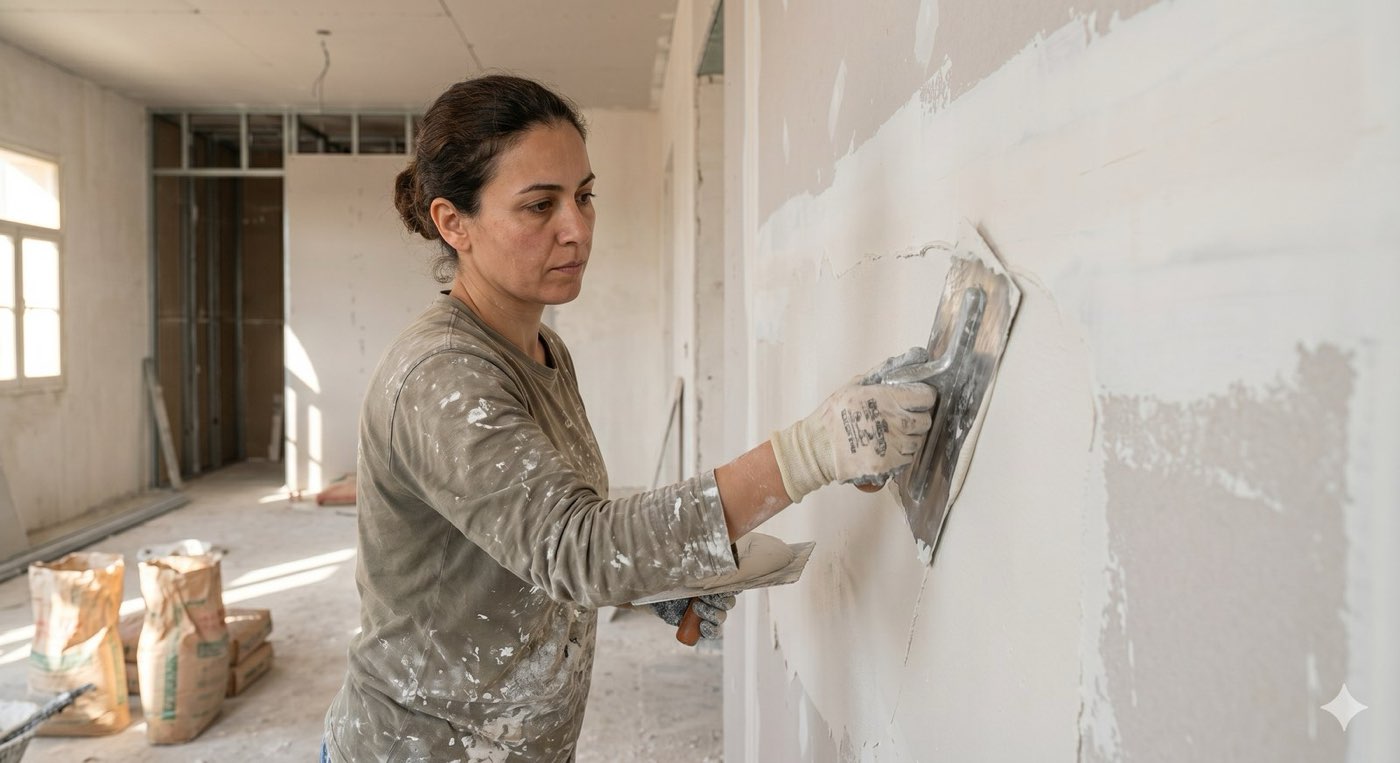
The question arrives in almost every enquiry, usually from someone who has bought or renovated in the UK: is your gypsum installer licensed? In Malta the honest answer is that the licence you are imagining does not cover this trade, and the skill card that was supposed to has been ten years in the making. That is not a scandal, but it does change where you should spend your attention.
What LN 166/2023 actually licenses
The contractor licensing regime that came into force under Legal Notice 166 of 2023 regulates three activities: demolition, excavation and construction (building). The BCA's own published FAQ document sets out the categories — including a mason's licence for the building activity — and finishing trades do not appear among them. Interior gypsum work, meaning plasterboard false ceilings, light troughs, bulkheads, stud partitions, dry-lining and skim plastering, is not a licensable activity.
The regime has teeth where it applies. Licensed contractors carry an insurance obligation, and operating outside the rules attracts penalties of up to EUR 50,000, with a further EUR 5,000 per day. Those numbers are worth knowing because they mark the boundary: on one side, a regulated activity with a licence and a fine schedule; on the other, your ceiling.
The boundary matters practically, because gypsum jobs rarely stay purely in gypsum. If your contractor is also knocking through a wall, cutting a new opening, or taking out masonry to make room for a partition, that element is demolition or building work and sits inside the regime. Ask who is doing it and under which licence. A firm that shrugs at the question is telling you something.
The skill card: announced in 2016, still waiting
Skill cards for construction workers were launched in 2016, and plasterers were one of the four founding trades. A decade later the BCA is taking applications — EUR 15 for a card, renewable every five years, covering health and safety together with trade competency. The BCA's FAQ page frames the scheme's effect with a conditional: once the subsidiary legislation is approved.
It has not been. Kamra tal-Periti's circular CIR 01/26, issued on 26 March 2026, records that the regulations were still being drafted. So as things stand a card is a credential, not a permission. A worker holding one has been through an assessment; a worker without one is not breaking any law. If a contractor's team holds cards, that is a genuine, if modest, data point. If someone tells you the card is legally required and theirs is pending, they are ahead of the legislation.
What actually protects you
Three things carry the weight that a licence would carry elsewhere: insurance, a written scope, and — in a block — the correct condominium consent.
Insurance. Because interior gypsum finishing is outside the licensing regime, the insurance obligation attached to that regime does not reach it. There is no published minimum cover for this trade. That makes it your question to ask, in writing, before work starts: who is insured, for what, and does the policy cover damage to third-party property — the flat below, the shaft, the neighbour's ceiling — as well as injury on site. Ask for the certificate, not a verbal assurance.
A written scope, priced by measure. Gypsum work is quantifiable in a way that most renovation is not. Ceilings and dry-lining are area work, measured in square metres. Light troughs, bulkhead returns and perimeter details are linear-metre work. A quote that gives you one number for "false ceilings throughout" cannot be checked, cannot be varied fairly, and cannot be compared against another quote. A quote that gives you m² of ceiling, linear metres of trough and bulkhead, board type and number of layers, and the treatment of openings, downlights and access hatches, can be.
This matters more in Malta than it would elsewhere because so much property changes hands in shell form. A shell has no reference surfaces: no finished floor level, no plaster line on the limestone, nothing to measure a soffit from. Agreeing the datum in writing — what the ceiling height will be measured from, and what happens if the screed comes in thicker than planned — prevents the most common dispute in the trade.
In Gozo, add delivery to the scope conversation. Every sheet of board crosses on the ferry, so part-loads and last-minute changes of board type cost days rather than hours. Fix the specification before the first delivery.
Condominium consent, and where a partition becomes everyone's business
If the property is a flat, the Condominium Act (Cap. 398) is the document that governs what you may fix and to what. Article 12 treats the slab dividing two storeys as a common part, with maintenance costs borne equally by the owner above and the owner below. Your ceiling hangs off something you only half own.
The consent thresholds follow from that. Alterations to common parts require a two-thirds majority of the condominium. Works that prejudice the stability or the security of the building require unanimity. Most suspended ceilings are light, reversible and unremarkable; but a partition that is fixed into a party wall, that penetrates a services shaft, or that is built tight to the underside of the slab is touching something shared. Get the fixing detail drawn, get the consent recorded in the condominium's minutes, and do it before the metalwork arrives. Retrospective consent is a negotiation; prior consent is a formality.
Height: check it before the frame goes up
A suspended ceiling takes height away — void for services, depth of the frame, thickness of the board. Malta applies a minimum clear height to habitable rooms, currently understood as 2.60 m, and that measurement is taken to the finished surface, not to the structural soffit. In a shell, with screed and finishes still to come, it is entirely possible to design a ceiling that works on paper and fails on site.
Do the arithmetic at quotation stage: structural soffit level, minus service void, minus frame and board, minus the finished floor build-up still to be laid. Have your perit confirm the figure rather than relying on the contractor's tape. This is the one dimension that cannot be fixed afterwards without stripping the ceiling out.
Fire resistance: nothing to specify against
British buyers often ask for a 30- or 60-minute ceiling as a matter of course. Malta has no equivalent number to quote. Kamra tal-Periti's 2020 framework paper describes a fire-safety system organised around a report rather than prescriptive requirements, resting on guidelines from 2004 that it characterises as obsolete, with no rules governing the materials used. First drafts of a new set of building safety codes, the fire code among them, were reported complete in June 2026.
Until those codes are in force, a fire rating on your ceiling is something you buy by contract. If you want fire-rated board, say so in the scope, name the build-up, and accept that you are specifying above a standard that does not yet legally exist for this element.
Before you sign
- Ask whether any part of the job involves demolition or building work, and who holds the licence for it.
- Ask for the insurance certificate and check it covers third-party property damage.
- Take a quote measured in m² and linear metres, with board type and layer count named.
- If it is a flat, establish what the works touch and obtain the two-thirds or unanimous consent accordingly, in the minutes.
- Confirm the finished clear height with your perit, including the floor build-up still to come.
- Decide on fire-rated board as a specification, not as a compliance assumption.
Skill cards, when the subsidiary legislation finally lands, will add a useful check. They will not replace any of the six above.
Common questions
- Does a gypsum contractor in Malta need a BCA licence?
- Not for interior gypsum finishing. The licensing regime introduced by LN 166/2023 regulates demolition, excavation and construction (building), and the BCA's own FAQ document lists those categories — including a mason's licence for building — without listing finishing trades such as plasterboard installation or skim plastering. If the same firm also breaks out masonry, chases a structural wall or carries out demolition as part of your job, that part of the work falls inside the regime.
- Is the Construction Industry Skill Card compulsory for plasterers?
- Not yet in any enforceable sense. Skill cards were launched in 2016 with plasterers among the first four trades, and the BCA is taking applications at EUR 15 for a card renewable every five years covering health and safety plus trade competency. But the BCA's FAQ conditions the scheme on the subsidiary legislation being approved, and Kamra tal-Periti's circular CIR 01/26 of 26 March 2026 records that the regulations were still being drafted. A card is evidence a worker has been assessed; it is not a licence, and its absence is not an offence today.
- Do I need the condominium's permission to build a stud partition in my flat?
- It depends on what the partition touches. Under Article 12 of the Condominium Act (Cap. 398) the slab between two storeys is a common part, with maintenance costs shared equally between the owners above and below. Works that alter common parts require a two-thirds majority, and works that prejudice the stability or security of the building require unanimity. A free-standing partition that dies into your own walls is different from one fixed through a party wall, into a shaft, or hard up to the underside of the slab — put the fixing detail in writing and get the consent before the trackwork goes in.
- What fire rating should I ask for on an apartment ceiling?
- There is no legal fire-resistance period you can point at. Kamra tal-Periti's 2020 framework paper describes a fire-safety regime built around a report rather than prescriptive rules, working off guidelines dating from 2004 that it calls obsolete, with no rules governing materials. A new set of building safety codes, including a fire code, reached first-draft stage as reported in June 2026. Until those are in force, any fire rating on your ceiling is a contractual specification you have chosen to buy, not a compliance item — so write the board type and build-up into the quote.
What we could not establish
- The sources do not say whether a contractor doing only interior gypsum finishing may voluntarily apply for a skill card now, nor what the trade-competency assessment for plasterers consists of.
- No source in this set states a minimum sum insured, a required policy type, or any insurance obligation at all for unlicensed finishing trades — the insurance obligation reported is attached to the licensing regime.
- The 2.60 m minimum clear height under LN 227/2016 is not established by any source in this set; treat the figure as a design constraint to verify with your perit rather than a citation.
- No source here publishes rates per m² or per linear metre for false ceilings, bulkheads, light troughs or dry-lining, nor any Gozo delivery surcharge.
- The content of the draft fire code — including whether it will set a fire-resistance period for apartment ceilings — is not published in these sources.
- Nothing in these sources establishes whether a public register of licensed contractors is searchable by homeowners, or how to verify a licence number.
Sources
- The licensing of contractors regime ... comes into force — BCA · read 2026-09-21
- FAQs - Construction Industry Licensing Regulations (PDF) — BCA · read 2026-09-21
- FAQs - Skill Card — BCA · read 2026-09-21
- CIR 01/26 - Construction Industry Skill Card — Kamra tal-Periti · read 2026-09-21
- Skill cards for construction workers launched (2016) — MaltaToday · read 2026-09-21
- The Maintenance of Roofs, Floors & Ceilings under Maltese Law — Mamo TCV · read 2026-09-21
- Malta Condominium Act Overview — SMM Group · read 2026-09-21
- A Modern Building & Construction Regulation Framework for Malta (PDF, 2020) — Kamra tal-Periti · read 2026-09-21
- First drafts of Malta's new building safety codes complete — Lovin Malta · read 2026-09-21
Want this costed properly?
The calculator gives you a figure in a minute. A site visit gives you a fixed price.
Book a free survey