
Fire-rated gypsum board: what Malta requires
There is no Maltese law prescribing a fire-resistance period for a ceiling or partition in a dwelling. This explains what governs instead, where fire board is still worth specifying, and what it costs at Maltese retail.
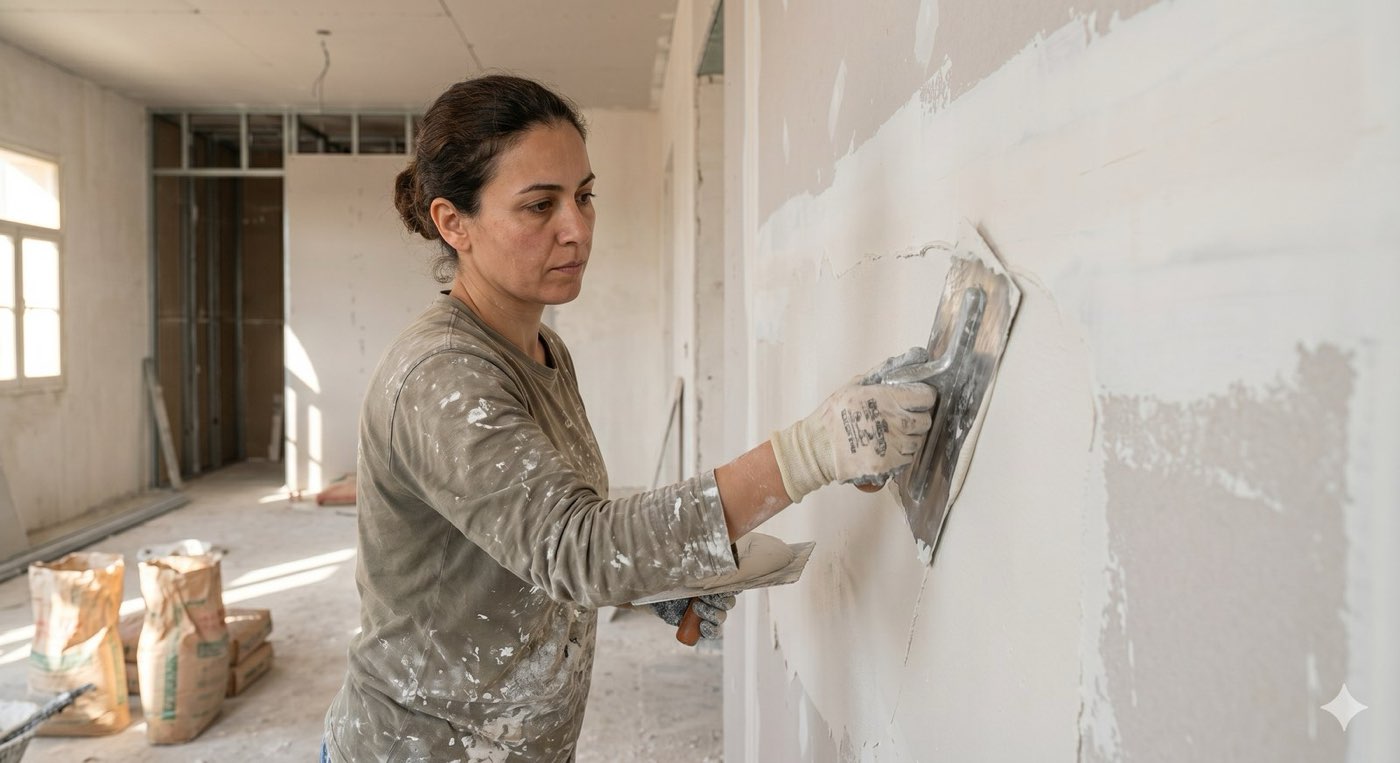
The short answer
If you are asking whether the plasterboard ceiling or stud partition in your Maltese flat is legally required to achieve a fire-resistance period, the answer is that no Maltese instrument states one for a dwelling. This surprises people arriving from the UK, where a domestic ceiling specification is driven by a number in a published document. Here there is no equivalent number to point at.
That is not the same as saying fire board is pointless. It means the decision is yours, or your perit's, or your development permit's — not a building regulation's.
What governs fire in a Maltese building at the moment
Malta's working reference has been the 2004 BICC Design guidelines for fire and safety in Malta. The Kamra tal-Periti's 2020 framework describes those guidelines as obsolete, and — the point that matters most for anyone buying boards — silent on materials and fabrics. A document that does not address materials cannot tell your installer which board to hang.
The Malta Chamber made the same case in June 2023: Malta follows out-of-date guidelines that carry no force of law. A Fire Safety Act was awaiting ratification, the Civil Protection Department's Director General said draft fire legislation was in its final stages, and the building codes themselves sit with the Building and Construction Authority.
A 2017 amendment to the Civil Protection Act did give the CPD power to set standards for fire prevention in buildings. The sources do not establish what was issued under that power, which is itself worth knowing before anyone tells you a particular board is "required by CPD".
The one route by which fire board becomes compulsory
There is a mechanism, and it runs through planning rather than through a building code. Compliance is assessed at planning stage through a fire-safety report prepared by a fire engineer, reviewed by the CPD in its role as a Planning Authority consultee. That report becomes part of the permit, and it is mandatory for the compliance certificate.
So if your development permit carries a fire-safety report, whatever that report specifies for ceilings, shafts, protected routes or separating walls is binding on your job — not because a regulation says fire board, but because your permit does. This is the single document to read before you brief a plasterer. On a shell-form apartment bought from a developer, the permit is the developer's; ask for the fire-safety report, not just the planning reference.
After that, nothing follows. The Kamra tal-Periti framework records that Malta has no system of continued inspection. Nobody comes back to verify that the pink board specified on paper is the board actually screwed to the frame.
What is coming
In January 2026 the Kamra tal-Periti signed with the BCA to draft 17 building codes and 6 construction codes, in 9 bundles, over three years. By June 2026 the structural-integrity and fire-safety bundles were complete in first draft. Stakeholder consultation comes first, then BCA public consultation. Nothing in that process binds a homeowner yet, and the drafts are not public, so there is no way to specify today against a code that does not exist.
Where fire board is still the sensible choice
With no prescribed period, the argument for fire board is practical rather than legal. The places it tends to earn its cost in a Maltese flat or townhouse:
- Kitchen ceilings and the boxing above hobs and ovens, where an ignition source sits directly under a suspended plane.
- Boxing around services — gas, electrical risers, extract ducting — particularly where the boxing runs between rooms or up through a ceiling void and would otherwise be a clear path.
- Walls onto common parts in an apartment block: the stairwell, the lift shaft, the landing. These are the surfaces where your drylining is also somebody else's escape route. Common parts are governed by Cap. 398 and the condominium rules bind what you may do to them; the fire question and the permission question are separate, and you need both answered.
- Letting stock. A landlord carrying the risk of other people's cooking has a reason to spend the difference that an owner-occupier may not.
Against that, a light trough in a bedroom, a bulkhead concealing a split-unit pipe run, or a flat skim ceiling in a dry hallway — these are not places where fire board changes any realistic outcome, and the extra cost is simply extra cost.
Note also that the two rules British arrivals most often cite are not fire rules at all. The 2.60 m clear-height requirement in LN 227/2016 is a habitable-room dimension, and it constrains how deep a false ceiling can drop; Technical Document F deals with energy, not fire. Neither says anything about board classification.
What boards are available in Malta, and what they cost
Maltese suppliers do stock fire-performance board. Evolve in Haz-Zebbug lists CoreX fire board (red) for internal use where higher fire resistance is needed, alongside A1 boards and premium boards offering enhanced fire, sound and impact performance together.
Retail pricing published by Gypsum Board Malta, per sheet:
| Board type | Price per sheet |
|---|---|
| Standard | EUR 6.82-11.00 |
| Moisture | EUR 11.22-18.80 |
| Fire (pink) | EUR 17.60-18.26 |
Read that table carefully. Fire board at the top of its range is a little under three times standard board at the bottom of its range — but the two ranges reflect different sizes and thicknesses that the source does not break down, so this is not a clean like-for-like multiple. What it does show is the order of magnitude: on a small kitchen ceiling the uplift is tens of euro, not hundreds. On a whole apartment it is a different conversation.
These are board prices only. They are not an installed rate. No Maltese source publishes a per-square-metre installed figure for fire-rated ceilings or partitions, and a UK or Italian installed rate is not a substitute — labour, access, delivery and the way Maltese ceilings are hung off concrete slab all differ. In Gozo, add the ferry to every pallet; nobody publishes what that adds either.
What to do with all this
- Read your permit. If there is a fire-safety report attached to it, that report — not general practice, not what your installer usually does — sets your specification.
- If there is no report, you are making a judgement call. Spend the difference where an ignition source or an escape route is involved, and don't elsewhere.
- Get the board written into the quotation by name and classification, not as "fire board". Colour is a manufacturer's marking, not a grade, and nobody will inspect afterwards.
- For anything touching common parts, settle the condominium permission before you settle the board.
The honest position is that Malta's fire rules for domestic plasterboard are a gap being filled slowly. Until the BCA codes emerge from consultation, specifying fire board is a decision about risk, not a matter of compliance.
Common questions
- Does the false ceiling in my Maltese flat have to be fire-rated?
- Not by any law that prescribes a fire-resistance period for a dwelling. Malta's design reference has been the 2004 BICC fire and safety guidelines, which the Kamra tal-Periti describes as obsolete and which are silent on materials and fabrics, and the Malta Chamber reported in 2023 that Malta follows out-of-date guidelines with no force of law. The exception is a condition in your own development permit, where a fire-safety report has been made part of it.
- What is the difference between pink board and red board?
- Both are fire-performance boards and the colour is the manufacturer's marking, not a legal grade. The Maltese retail listings call fire board pink; Evolve in Haz-Zebbug sells CoreX fire board described as red, for internal use where higher fire resistance is needed. Evolve also lists A1 boards and premium boards with enhanced fire, sound and impact performance. Ask for the specific board's declared classification rather than relying on colour.
- How much more does fire board cost than standard board?
- At Maltese retail, Gypsum Board Malta lists fire board (pink) at EUR 17.60-18.26 per sheet, standard board at EUR 6.82-11.00 and moisture board at EUR 11.22-18.80. Those are board prices only; no Maltese source publishes an installed rate per square metre for a fire-rated ceiling or partition.
- Will anyone inspect a fire-rated ceiling after it is built?
- The Kamra tal-Periti framework states plainly that Malta has no system of continued inspection. Where a fire-safety report forms part of a development permit, it is mandatory for the compliance certificate, so the check happens on paper at that point rather than through routine site inspection afterwards.
- Is new legislation coming?
- Yes, in draft. The Kamra tal-Periti signed with the Building and Construction Authority in January 2026 to draft 17 building codes and 6 construction codes in 9 bundles over three years. The structural-integrity and fire-safety bundles were complete in draft by June 2026, with stakeholder consultation and then BCA public consultation to follow.
What we could not establish
- No source gives a fire-resistance period in minutes for any element of a Maltese dwelling - ceiling, partition, or common-part wall. Anyone quoting you '30 minutes' or '60 minutes' as a Maltese legal requirement is importing it from elsewhere.
- The Maltese retail prices are per sheet, but the sources do not state sheet dimensions or board thickness, so the figures cannot be converted to a reliable price per square metre.
- No Maltese installed rate exists in any source for fire-rated ceilings or partitions. Foreign installed rates cannot stand in for one.
- The sources do not establish what standards, if any, the Civil Protection Department actually issued under the 2017 amendment to the Civil Protection Act that gave it the power to set them.
- The draft fire-safety code of June 2026 has not been published, so whether it will prescribe board classifications for dwellings is unknown.
- No source addresses whether condominium common parts under Cap. 398 carry any specific fire rating obligation, or who in a block would enforce one.
- Nothing in the sources covers fire-stopping of service penetrations, ceiling void compartmentation, or downlight fire hoods in Maltese practice.
Sources
- A Modern Building & Construction Regulation Framework for Malta (PDF, 2020) — Kamra tal-Periti · read 2026-10-05
- Igniting Change: The need for fire safety legislation in Malta (16 Jun 2023) — The Malta Chamber · read 2026-10-05
- First drafts of Malta's new building safety codes complete (17 Jun 2026) — Lovin Malta · read 2026-10-05
- Gypsum Board Malta (online store) — Gypsum Works Malta / APTC Turnkey Contractors (A.P.T.C Ltd), Malta · read 2026-10-05
- Gypsum Boards & Plaster Malta — Evolve - By RS Group (Haz-Zebbug) · read 2026-10-05
Drafted with Claude — claude-opus-5, then read, corrected and approved by Neil Bennett before publication. We do not publish anything a person has not read.
Want this costed properly?
The calculator gives you a figure in a minute. A site visit gives you a fixed price.
Book a free survey